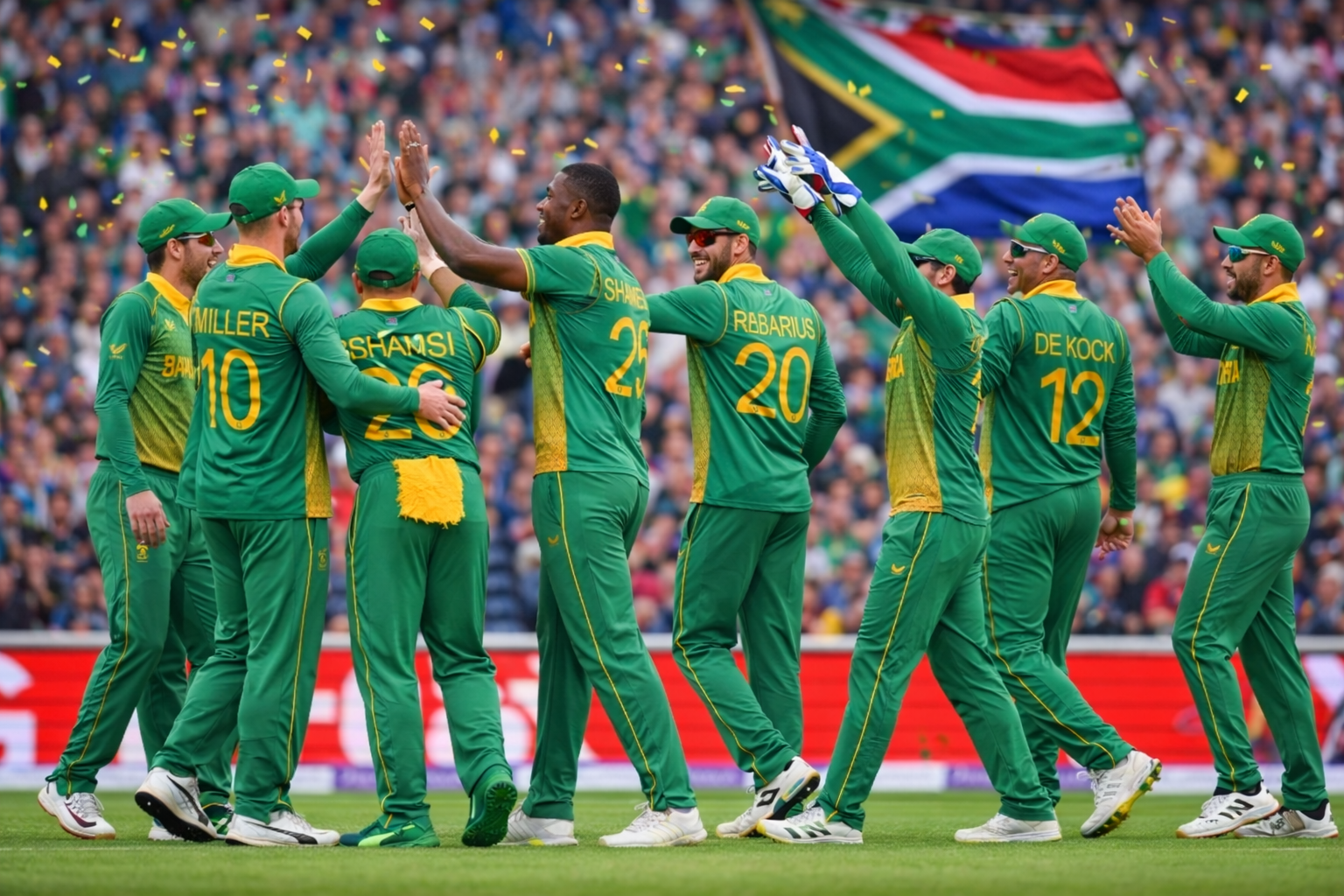
| No. | Date | Match | Venue | South Africa Players | England Players | Result |
|---|---|---|---|---|---|---|
| 1 | 14 Sep 2025 | 3rd T20I | Trent Bridge, Nottingham | Aiden Markram, Ryan Rickelton, Dewald Brevis, David Miller, Marco Jansen, Keshav Maharaj | Harry Brook, Phil Salt, Jos Buttler, Jamie Smith, Jofra Archer, Adil Rashid | Abandoned |
| 2 | 12 Sep 2025 | 2nd T20I | Old Trafford, Manchester | Aiden Markram, Ryan Rickelton, Tristan Stubbs, David Miller, Marco Jansen, Lizaad Williams | Phil Salt, Jos Buttler, Harry Brook, Jacob Bethell, Jofra Archer, Adil Rashid | England won by 146 runs |
| 3 | 10 Sep 2025 | 1st T20I | Cardiff | Aiden Markram, Ryan Rickelton, Tristan Stubbs, David Miller, Corbin Bosch, Keshav Maharaj | Phil Salt, Jos Buttler, Harry Brook, Liam Dawson, Sam Curran, Jofra Archer | South Africa won by 14 runs (DLS) |
| 4 | 7 Sep 2025 | 3rd ODI | Southampton | Aiden Markram, Ryan Rickelton, Temba Bavuma, Rassie van der Dussen, Heinrich Klaasen, Keshav Maharaj | Joe Root, Harry Brook, Ben Duckett, Jos Buttler, Jamie Smith, Jofra Archer | England won by 342 runs |
| 5 | 4 Sep 2025 | 2nd ODI | Lord’s, London | Aiden Markram, Ryan Rickelton, Temba Bavuma, Aiden Markram, Marco Jansen, Keshav Maharaj | Joe Root, Harry Brook, Jos Buttler, Jamie Smith, Jofra Archer, Adil Rashid | South Africa won by 5 runs |
| 6 | 2 Sep 2025 | 1st ODI | Headingley, Leeds | Aiden Markram, Ryan Rickelton, Temba Bavuma, Rassie van der Dussen, Tristan Stubbs, Keshav Maharaj | Jamie Smith, Ben Duckett, Joe Root, Harry Brook, Jos Buttler, Brydon Carse | South Africa won by 7 wickets |
| 7 | 1 Mar 2025 | Champions Trophy, Group B | Karachi | Aiden Markram, Ryan Rickelton, Temba Bavuma, Heinrich Klaasen, David Miller, Kagiso Rabada | Joe Root, Ben Duckett, Harry Brook, Jos Buttler, Liam Livingstone, Jofra Archer | South Africa won by 7 wickets |
| 8 | 21 Jun 2024 | T20 World Cup, Super 8 | St Lucia | Quinton de Kock, Reeza Hendricks, Aiden Markram, Heinrich Klaasen, David Miller, Kagiso Rabada | Jos Buttler, Phil Salt, Jonny Bairstow, Harry Brook, Liam Livingstone, Jofra Archer | South Africa won by 7 runs |
| 9 | 21 Oct 2023 | ODI World Cup | Mumbai | Quinton de Kock, Temba Bavuma, Rassie van der Dussen, Aiden Markram, Heinrich Klaasen, Marco Jansen | Jonny Bairstow, Dawid Malan, Joe Root, Ben Stokes, Jos Buttler, Harry Brook | South Africa won by 229 runs |
| 10 | 1 Feb 2023 | 3rd ODI | Kimberley | Temba Bavuma, Quinton de Kock, Rassie van der Dussen, Aiden Markram, David Miller, Kagiso Rabada | Jason Roy, Dawid Malan, Jos Buttler, Harry Brook, Moeen Ali, Sam Curran | England won by 59 runs |
When you think of cricket rivalries that combine intensity, history, and sheer talent, the clash between the South Africa national cricket team and the England cricket team players instantly comes to mind. This rivalry dates back to the late 19th century, making it one of the oldest and most compelling narratives in international cricket. England toured South Africa as early as 1888–89, and since then, the two nations have engaged in countless memorable battles across Test, ODI, and T20 formats.
What makes this rivalry particularly interesting is how it evolved over time. South Africa’s isolation from international cricket during the apartheid era temporarily paused the competition, but its return in 1991 reignited the fire. Since then, matches between these two teams have often been unpredictable, swinging like a pendulum between dominance and defeat.
From iconic Test series to nail-biting World Cup encounters, both teams have contributed players who left lasting marks. Think of legends like Jacques Kallis and Graeme Smith on one side, and Andrew Flintoff and Alastair Cook on the other. These players didn’t just compete—they defined eras.
This rivalry isn’t just about matches; it’s about contrasting styles. England often brings a structured, strategic approach, while South Africa thrives on raw pace and athleticism. That contrast makes every encounter feel like a chess match played at lightning speed.
Why This Rivalry Captivates Fans Worldwide
There’s something undeniably magnetic about watching England vs South Africa cricket players face off. It’s not just the skill—it’s the drama, the unpredictability, and the personalities involved. Fans from both nations—and even neutral viewers—tune in because they know they’re about to witness high-quality cricket.
One reason this rivalry stands out is the balance between the teams. Unlike some one-sided rivalries, England and South Africa have often been evenly matched. That means every match carries real stakes, and no result is ever guaranteed. It’s like watching two heavyweight boxers who both have knockout power—you never know who will land the decisive punch.
Another factor is the diversity in playing conditions. Matches in England test players with swinging conditions and overcast skies, while South African pitches offer bounce and pace. This forces players to adapt, showcasing their versatility and mental toughness.
The players themselves also add to the spectacle. Modern stars like Joe Root, Ben Stokes, Kagiso Rabada, and Quinton de Kock bring flair, aggression, and consistency. Their individual battles—bat vs ball, captain vs captain—create mini-stories within the larger narrative.
Ultimately, this rivalry captivates because it’s more than just cricket. It’s a blend of history, national pride, and individual brilliance that keeps fans coming back for more.
Overview of South Africa National Cricket Team Players
Key Batters in South Africa Squad
The South Africa national cricket team players have long been known for producing technically sound yet aggressive batters. Over the years, the Proteas have built a reputation for having a batting lineup that can both anchor an innings and accelerate when needed.
In the current era, players like Temba Bavuma, Aiden Markram, Rassie van der Dussen, and Quinton de Kock form the backbone of the batting unit. Each of these players brings a unique dimension. Bavuma, for instance, is known for his composure and ability to handle pressure, while Markram combines elegance with attacking intent.
Quinton de Kock, arguably one of the most dangerous wicketkeeper-batters in modern cricket, plays with a fearless approach. He doesn’t just score runs; he changes the tempo of the game. Meanwhile, van der Dussen is the glue that holds the middle order together, often stepping up when the team is in trouble.
What sets South African batters apart is their adaptability. They are comfortable playing on bouncy home pitches as well as swinging conditions abroad. This versatility makes them formidable opponents, especially in multi-format series.
Strengths and Playing Style of SA Batters
South African batters are often described as a perfect blend of classical technique and modern aggression. Their playing style is built on strong fundamentals—solid defense, precise footwork, and the ability to play both pace and spin effectively.
One of their biggest strengths is their ability to handle fast bowling. Growing up on pitches that favor pace, South African players develop the confidence to face high-speed attacks. This gives them an edge when playing against teams like England, which rely heavily on seam and swing bowling.
Another defining trait is their mental resilience. South African batters are known for building partnerships and grinding out innings when required. At the same time, they can switch gears and score quickly, especially in limited-overs formats.
Their field awareness and running between the wickets also stand out. They don’t just rely on boundaries; they rotate strike efficiently, keeping the scoreboard ticking. This makes it difficult for bowlers to settle into a rhythm.
In essence, South Africa’s batting lineup is like a well-balanced orchestra—each player plays a different instrument, but together, they create a harmonious and powerful performance.
Leading Bowlers in South Africa Team
Pace vs Spin Attack Breakdown
If there’s one area where the South Africa cricket team players consistently dominate, it’s bowling. The Proteas have produced some of the most feared fast bowlers in cricket history, and the current lineup continues that tradition.
At the forefront is Kagiso Rabada, a world-class pacer known for his speed, accuracy, and ability to take wickets in crucial moments. Alongside him, players like Anrich Nortje and Lungi Ngidi add depth and variety to the pace attack. Nortje’s raw pace can unsettle even the best batters, while Ngidi’s disciplined line and length make him a reliable option.
South Africa’s pace attack thrives on aggression. They use short balls, yorkers, and seam movement to keep batters on the back foot. This approach is particularly effective on home pitches, where bounce and carry play a significant role.
Spin bowling, while not as dominant, still plays an important role. Bowlers like Keshav Maharaj provide control and variation, especially in longer formats. Maharaj’s ability to maintain tight lines and pick up crucial wickets makes him a valuable asset.
The balance between pace and spin allows South Africa to adapt to different conditions. Whether it’s exploiting swing in England or bounce at home, their bowling unit is versatile and dangerous.